

Certification Evaluation · Australia
Lean Six Sigma Certification in Australia: How to Evaluate the Body Behind the Credential
Choosing a lean six sigma certification australia provider is a risk decision, not a shopping decision. Australian employers write the cheque, but they inherit the fallout when the body behind the credential cannot be verified, is not recognised by the next employer, or does not survive a procurement audit. Individual professionals carry the same risk: a certificate that cannot be verified is a certificate that does not count.
This guide is written for HR directors, L&D managers, procurement leads, heads of operational excellence, and learners deciding where to invest their own time and money. It explains the three certification bodies Australian buyers encounter, how to verify any provider’s accreditation in under two minutes, and what disqualifies a credential before any money changes hands. It finishes with a worked example: how to verify Lean Sigma Experts Australia’s own accreditations using the same method you should apply to every other provider.

Why Certification-Body Choice Matters in Australia
Australian enterprises no longer treat Lean Six Sigma training as optional capability. In regulated industries such as healthcare, resources, defence, utilities, and critical infrastructure, Six Sigma credentials show up in tender submissions, capability audits, and ISO-aligned compliance reviews. When the body behind the credential cannot be named, verified, or cross-checked, the certificate becomes a procurement liability instead of a capability asset.
The commercial exposure sits in four places. First, portability: a certificate from an unknown or defunct body will not transfer when an employee moves to a new employer, a new project, or a tender-qualified supplier list. Second, audit defensibility: internal audit teams increasingly ask to see the issuing body, the accreditation status of the training provider, and the verification URL. Third, public-sector procurement: state-government and federal-agency panels are moving toward verified qualifications as a baseline requirement, not a tie-breaker. Fourth, reputational risk: a Lean Six Sigma deployment that relies on unverifiable belts is a deployment that cannot defend its own governance.
For a buyer-side view of how Australian executives should evaluate and engage external consulting support beyond the certification itself, see our companion guide on Lean Six Sigma consulting in Australia.
For individual learners, the risk is different but equally real. A credential that cannot be verified is a credential that will not survive a recruitment check, a LinkedIn audit, or a professional-body review. The cost of an unverifiable certificate is paid in forgone promotions, not in upfront fees.
The Three Bodies Behind Every Lean Six Sigma Certification Australia Buyers Should Know
Three international bodies issue or accredit the overwhelming majority of Lean Six Sigma certifications that Australian employers and learners encounter. Each has a distinct assessment model, portability profile, and sector recognition pattern. Understanding these three is the foundation of any defensible certification decision.
CSSC (Council for Six Sigma Certification)
CSSC is a US-based accrediting body founded in 2005. It accredits training organisations globally and recognises a broader assessment model that includes review-based certification, instructor-assessed projects, and examination. Belts covered include White, Yellow, Green, Black, and Master Black Belt. CSSC is particularly flexible for self-paced and blended learners and has wide recognition across Asia-Pacific operational environments, including a direct Australian presence on the CSSC register.
ILSSI (International Lean Six Sigma Institute)
ILSSI is a UK-based institute that issues Cambridge-referenced credentials and modern digital badges backed by blockchain verification. Its assessment model emphasises applied project work over pure examination, which makes it well suited to practitioners who want verifiable evidence of real-world deployment rather than a test score. Recognition is growing steadily in Europe and increasingly in Australia, especially among consulting and continuous-improvement professionals.
PeopleCert IASSC
PeopleCert IASSC is the combined authority that resulted when PeopleCert, the global certification body best known for ITIL and PRINCE2, acquired the International Association for Six Sigma Certification (IASSC) and its Lean Six Sigma portfolio. The combined body uses proctored, closed-book, multiple-choice examinations administered under PeopleCert’s global proctoring infrastructure, maintains the public IASSC accredited-provider directory, and issues credentials that sit alongside the broader PeopleCert professional-certification family. Belts covered include Yellow, Green, Black, and Lean. Recognition is strongest in manufacturing, aerospace, defence supply chains, IT services, and enterprises that value exam-based consistency across geographies or that already standardise on PeopleCert frameworks such as ITIL.
How to Verify a Lean Six Sigma Certification in Australia
The five-step process below works for any certification body and any training provider operating in Australia. Complete it before you enrol a learner, approve a supplier, or authorise a purchase order. For most providers, the entire verification takes under two minutes.
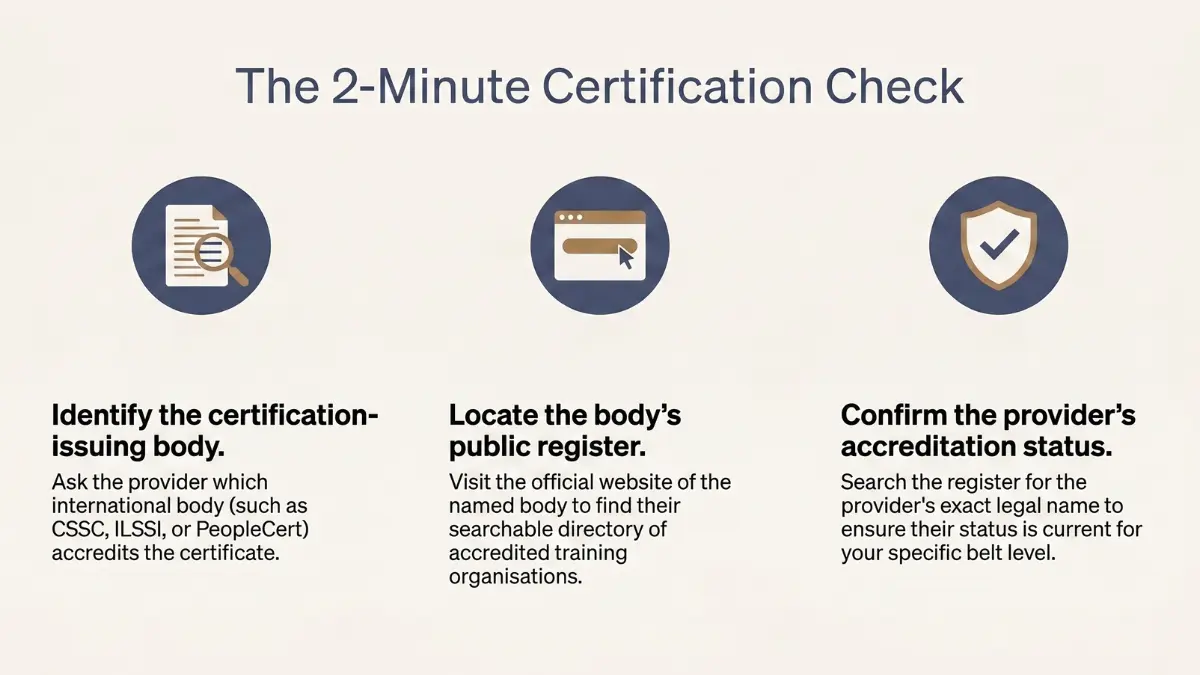
- Identify the certification-issuing body. Ask the training provider which body issues or accredits the certificate and get the answer in writing. If the provider cannot name the body, or names a body that does not have a public website, stop. The certification has no verifiable parent.
- Locate the body’s public accreditation register. Every legitimate body publishes a searchable register of accredited training providers. CSSC’s training provider listings sit at sixsigmacouncil.org, ILSSI’s partner list at ilssi.org, and PeopleCert IASSC’s accredited-provider directory at iassc.org. If the body does not publish a register, it is not a certification body you should rely on.
- Confirm the training provider’s name and accreditation status. Search the register using the provider’s exact legal entity name, not just the trading name. Confirm that the accreditation is current, not expired, and covers the specific belt level you intend to purchase. A provider accredited for Green Belt only cannot issue a verifiable Black Belt.
- Confirm the candidate’s certificate record, where available. Some bodies, notably PeopleCert IASSC and ILSSI, offer per-candidate verification via a public URL or unique credential ID. If the provider’s own certificates do not include a verifiable ID, ask why. If the answer is vague, the certificate is vague.
- Document the verification for your own records. Save a screenshot or PDF of the register entry, the candidate record where available, and the date of verification. Procurement, internal audit, and future employers all benefit from this paper trail, and the effort is trivial compared with the downstream cost of an unverifiable credential.
What a Credible Training Provider Looks Like
Accreditation is a necessary condition, not a sufficient one. A provider can hold current accreditation and still deliver a weak program. Four additional criteria separate credible providers from paper-credentialed ones.
Current accreditation that lives on the body’s register
The proof sits on the certification body’s public register, not on the provider’s marketing page. If the only evidence of accreditation is a logo on the provider’s website, it is not evidence. The entity name on the register should exactly match the legal entity you are transacting with, or be a clearly documented related entity within the same group.
Examination structure that matches the credential
A Black Belt earned without an exam, without a project, or without instructor assessment is a weaker credential than one that required all three. Ask the provider to describe, in writing, how each belt level is assessed. Proctored exam, applied project, instructor review, or combination: all acceptable. Certificate-by-completion-only: not acceptable at Green Belt or above.
Trainer pedigree that holds up to scrutiny
Named trainers with public profiles, verifiable credentials, and a consulting track record inside real deployments. Stock-photo trainers, anonymous faculty, and trainers who cannot be found on LinkedIn or on the certification body’s individual register are a serious red flag. This is one of the single biggest quality differentiators between accredited providers at the same price point.
Curriculum fit for Australian context
Case studies drawn from local sectors such as healthcare, resources, utilities, and government, compliance and safety vocabulary that matches Australian regulatory reality, and faculty who have actually run deployments inside Australian enterprises. A curriculum built entirely around overseas case material is usable, but it costs the learner time translating into the local context that matters for their career. Our partner and affiliate network exists to strengthen this local fit.
Comparison: CSSC vs ILSSI vs PeopleCert IASSC
The table below summarises how the three bodies compare across the attributes Australian buyers ask about most often. The cost-range entries are directional only and assume public-course pricing rather than negotiated enterprise rates.
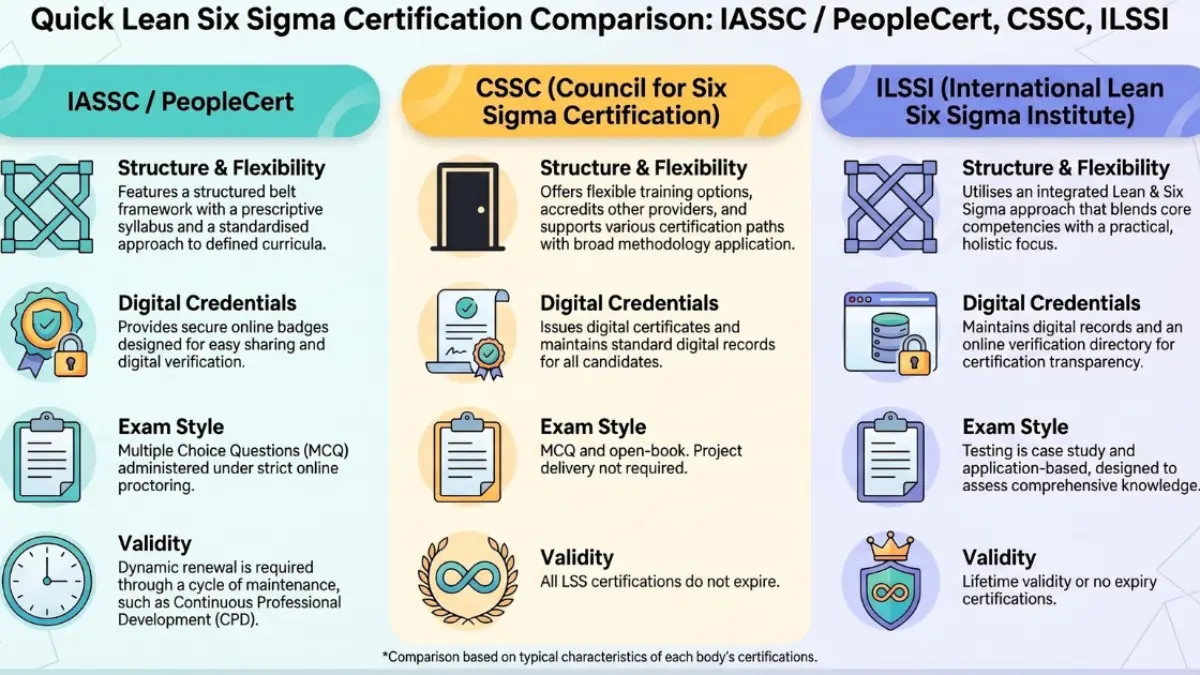
| Body | Exam structure | Validity | Portability | Cost range (directional) |
|---|---|---|---|---|
| CSSC | Open-book, Multiple-choice questions | Lifetime | High across Asia-Pacific, with direct AU-listed providers | Lower-to-mid |
| ILSSI | Proctored, open-book, Multiple-choice questions, digital badge issued | Lifetime | Growing across UK, Europe, Australia | Lower-to-mid |
| PeopleCert IASSC | Proctored, closed-book, multiple-choice exam under PeopleCert’s global proctoring infrastructure | Renewal every 3 years | Very high, especially in manufacturing, defence, IT services, and PeopleCert-aligned enterprises | Mid-to-upper |
For a deeper comparison that focuses specifically on these three bodies from an Australian buyer’s perspective, see our detailed comparison of IASSC, CSSC, and ILSSI. The short version: choose PeopleCert IASSC when proctored exam rigour and global portability are the primary buyer signals, choose CSSC when you need assessment flexibility, a direct Australian-listed provider, and wide Asia-Pacific reach, and choose ILSSI when modern digital credentials and applied project evidence matter most.
Red Flags: What Disqualifies a Lean Six Sigma Certification Provider
The following patterns disqualify a provider before any commercial conversation begins. Any single one of them should be treated as a hard stop, not a negotiation point.
The provider cannot name the certification body
If the sales team cannot tell you which body issues or accredits the certificate, the certificate has no verifiable parent. This is the single most common failure mode and the fastest one to disqualify.
The body’s website cannot be reached or has no accreditation register
A certification body that does not publish a searchable register of accredited providers is not operating at a level Australian employers should rely on. Register publication is a baseline expectation.
The provider is not listed on the body’s register
A logo on the provider’s marketing page is not evidence. The provider must appear on the body’s own public register, under their legal entity name, for the specific belt level you are purchasing.
Certificates are issued without a verifiable ID or verification URL
Modern credentials should be verifiable per-candidate. If the provider cannot tell you how a future employer or procurement team would confirm that a specific certificate is authentic, the certificate has limited downstream value.
The examination is optional, or can be “passed” without any assessment
A certification-by-completion model is not a Lean Six Sigma certification in any meaningful sense. Watch for programs that advertise “no exam required” above Yellow Belt.
Trainers are not named or not verifiable
A Black Belt program taught by an unnamed instructor is not a Black Belt program. Trainer verifiability is proxy evidence for curriculum quality and deployment experience.
The provider will not answer basic procurement questions in writing
If you cannot get accreditation status, assessment structure, trainer credentials, and verification URLs in writing before purchase, assume you will not be able to get them after purchase either. This is a procurement smell test, and it is surprisingly reliable.
How Lean Sigma Experts Australia’s Credentials Verify
Lean Sigma Experts Australia’s accreditations can be verified by any Australian employer or learner using exactly the five-step method described in Section 3. The table below lists each certification body, what it verifies, and the live external URL that proves it. This is the same evidence we expect our own buyers to demand of us, and the same evidence you should demand of any other provider you consider.
| Body | What they verify | Verification URL | LSEA / MBIZM status |
|---|---|---|---|
| CSSC | Accredited Training Organisation status, direct Australian listing | sixsigmacouncil.org Adelaide register entry | Lean Sigma Experts Australia, Adelaide, South Australia: accredited across White, Yellow, Green, and Black Belt |
| ILSSI | Accredited Training Partner status | ilssi.org partner profile | First accredited ILSSI training partner in Australia |
| PeopleCert IASSC | Accredited Provider status | iassc.org provider listing | Meridian Biz Management Sdn Bhd (MBIZM Group), accreditation number 02-1019, accredited since April 2012 |
Any Australian employer or learner can confirm LSEA’s accreditation in under two minutes. Open each of the three external URLs in the table and check the register entries. The entity names to look for are Lean Sigma Experts Australia (direct Australian listing on both the CSSC register in Adelaide and the ILSSI partner list) and Meridian Biz Management Sdn Bhd (on the PeopleCert IASSC register as part of MBIZM Group). This is the same verification procedure we recommend you apply to every other provider you consider.
Dr Satnam Singh, Founder of MBIZM Group and Principal Consultant at Lean Sigma Experts Australia, personally holds a Certified Lean Six Sigma Black Belt (CSSC), Certified Lean Expert (PeopleCert IASSC), ITIL (PeopleCert), PRINCE2 project-management certification, and Certificate IV in Training and Assessment (TAE40110). His credentials are individually verifiable through the respective bodies’ per-candidate registers. This is what trainer pedigree looks like when it is designed to hold up to buyer scrutiny. For more detail on his background, see Dr Satnam Singh’s profile, and for the full list of accreditations alongside the verification logic, see our accreditation page.
Which Certification Body Suits Which Career Path
Belt level matters. So does sector. The combination is what should guide the body choice, not marketing volume.
By belt level
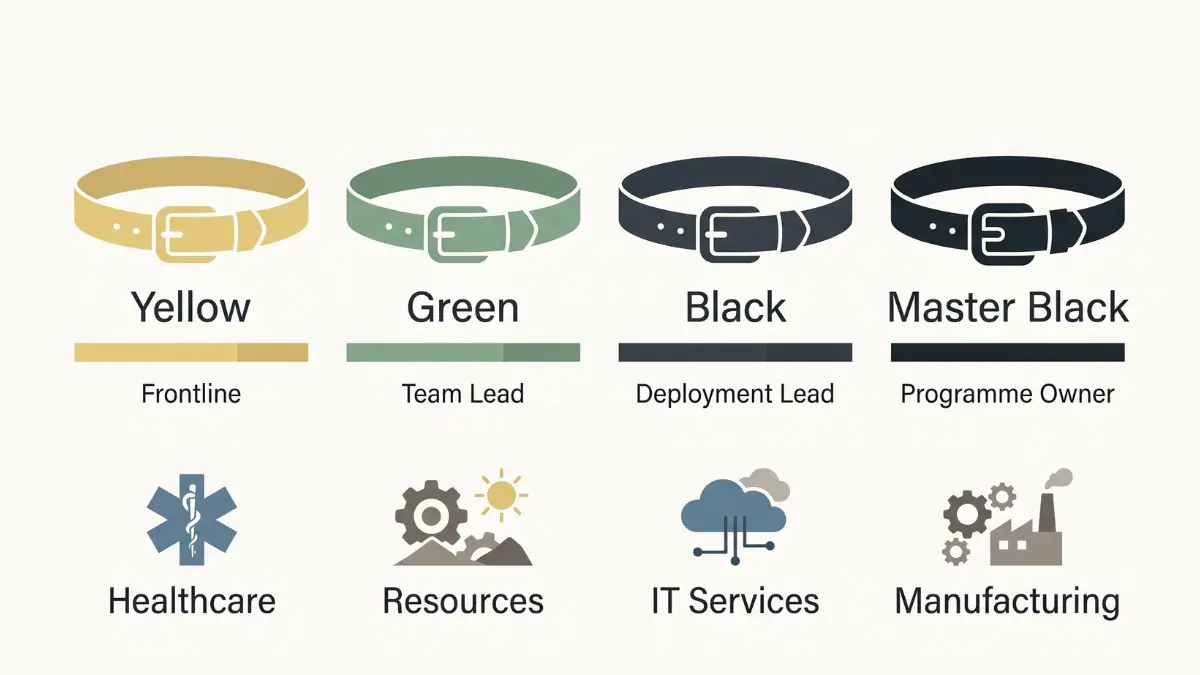
At Yellow Belt, the stakes are low and either PeopleCert IASSC or CSSC works well for frontline staff, project participants, and support roles. Choose CSSC for self-paced flexibility, PeopleCert IASSC for proctored-exam rigour that reads well on a CV in manufacturing or defence.
At Green Belt, the stakes start to rise. Team leads, process owners, and first-line consultants benefit from PeopleCert IASSC where the target sector is IT services or PeopleCert-framework-heavy environments, and from CSSC or ILSSI where the target is operational or consulting work.
At Black Belt, choice of body becomes a meaningful career signal. PeopleCert IASSC carries weight in defence, manufacturing, aerospace supply chains, and any enterprise that already standardises on PeopleCert frameworks such as ITIL or PRINCE2. CSSC reads well across diversified Asia-Pacific operational environments and benefits from a direct Australian-listed provider base. ILSSI is increasingly attractive to practitioners who want modern digital-credential verification and applied-project evidence rather than exam-only proof.
At Master Black Belt, fewer bodies certify and the certificate matters less than demonstrated portfolio. Evidence of sustained Black Belt work, financial impact, and enterprise-scale deployment experience matters more than which logo sits on the parchment.
By Australian sector
Healthcare, government, and critical infrastructure buyers tend to prefer CSSC or PeopleCert IASSC. IT services, financial services, and telecommunications often align with PeopleCert IASSC, especially where ITIL and PRINCE2 are already embedded. Manufacturing, resources, and defence lean toward PeopleCert IASSC or CSSC. Consulting, training delivery, and internal continuous-improvement leadership pair well with ILSSI or CSSC. For a more personal fit discussion, see which Lean Six Sigma certification suits you best, and for a sense of the deployment environments these choices play out in, see our client portfolio covering Australian and Asia-Pacific organisations.
How to Make a Defensible Certification Decision
A defensible certification decision is not the cheapest one. It is the one that survives an audit, a procurement review, and the next job interview. Before you sign any purchase order or enrolment, ask the four defensibility questions.
First, can you name the body? If you cannot say, in a meeting with your CFO, “this certificate is issued by X and accredited by Y,” the certificate is already a liability. Second, can you verify the provider on that body’s register, today? Not last year, not “usually”: today, on the public URL. Third, can you verify the individual credential, when it is issued? Per-candidate verification is the modern standard; a certificate without it is a certificate with a short shelf life. Fourth, would this decision survive a tender audit or a senior-management review? If the answer is “I’d rather not have to explain it,” do not proceed.
If any of the four answers is “no” or “I don’t know,” do not proceed. The downstream cost of an unverifiable credential is always higher than the upfront cost of choosing a verifiable one, and the consulting services you put behind that credential are only as defensible as the certification itself.
Frequently Asked Questions
How do I verify that a Lean Six Sigma certification in Australia is legitimate?
Follow a two-minute process. Ask the provider which body issued the certificate, visit the body’s public register, confirm the provider’s exact legal entity is listed and currently accredited for the belt level in question, and save a screenshot with the verification date. For individual credentials, check whether the body offers a per-candidate verification URL. If any step fails (no named body, no register, not listed, no verifiable ID), the certification is not verifiable and should be treated as commercially and audit-unsafe.
What is the difference between PeopleCert IASSC, CSSC, and ILSSI certifications?
PeopleCert IASSC is the combined body formed when PeopleCert, the global certification authority best known for ITIL and PRINCE2, acquired the IASSC (International Association for Six Sigma Certification). It uses proctored, closed-book, multiple-choice exams under PeopleCert’s global proctoring infrastructure and is well recognised across manufacturing, defence, aerospace, and IT services. CSSC (Council for Six Sigma Certification) is US-based but assesses via instructor review and project work, is widely recognised across Asia-Pacific, and has direct Australian-listed providers on its register. ILSSI (International Lean Six Sigma Institute) is UK-based, uses applied project assessment, and issues modern digital credentials aligned with Cambridge-style academic referencing. Choose the body whose exam style, portability, and industry recognition matches your sector.
Do Australian employers recognise overseas-issued Lean Six Sigma certifications?
Yes, because the three major bodies in this space are international. CSSC is US-based (with direct Australian-listed providers on its register), ILSSI is UK-based, and PeopleCert IASSC is global. What Australian employers look for is not a local-Australian issuer but verifiable accreditation against a recognised international standard. That said, a training provider with an Australian legal entity, Australian-based trainers, and Australian sector case studies will always be easier to procure against than a purely offshore provider. This is why Lean Sigma Experts Australia is structured as an Australian-registered delivery arm backed by MBIZM Group’s internationally accredited parent entities.
Does a Lean Six Sigma certification expire, and do I need to renew it?
Lean Six Sigma certification validity depends on the awarding body. For IASSC (now administered under PeopleCert), certifications are considered lifetime credentials; however, they require recertification every 3 years to maintain “Current” status. If not renewed, the certification remains valid but is marked as “Elapsed.” CSSC and ILSSI certifications are generally issued as lifetime credentials without mandatory renewal requirements. PeopleCert/IASSC certifications follow a maintenance cycle to ensure alignment with current standards. In practice, employers may still recognise the certification regardless of status, but often value recent application and project experience.
Which Lean Six Sigma certification in Australia is best for career progression?
The right Lean Six Sigma certification in Australia for career progression depends on the sector you want to move into, not on which body sounds most prestigious. If your target is manufacturing, resources, defence, or critical infrastructure, a PeopleCert IASSC or CSSC Black Belt carries weight. If your target is IT services, financial services, or telecommunications, PeopleCert IASSC tends to align with existing enterprise frameworks such as ITIL and PRINCE2. If your target is consulting, internal continuous-improvement leadership, or a training career, ILSSI or CSSC work well because they combine structured learning with applied project evidence. Whatever body you choose, evidence of completed projects, quantified results, and verified credentials matter more than the logo on the certificate.
Can I trust online-only Lean Six Sigma certification providers?
You can, if the online-only provider meets the same verification bar as an in-person provider. That means current accreditation on a recognised body’s public register, a named examination or assessment structure that matches the belt level, trainers with verifiable credentials, and per-candidate credential verification where the body supports it. Online delivery is a format, not a credential-quality indicator. The weakness to watch for is not online learning itself; it is the absence of any assessment. A Black Belt earned by watching videos without a project or an exam is not a Black Belt any audit will accept, online or otherwise.