

Buyer’s guide for Australian executives
Lean Six Sigma Consulting in Australia: What Executives Should Expect Before They Engage
When Australian executives evaluate lean six sigma consulting australia providers, the question is rarely whether the methodology works. The real question is whether a consulting engagement, rather than internal training or a single-point-solution hire, is the right way to solve a specific operational problem within a defined window.
This guide is written for Chief Operating Officers, Chief Financial Officers, heads of operations, transformation leads, and executive sponsors comparing consulting options in the Australian market. It sets out what reputable Lean Six Sigma consulting actually delivers, what it does not, how engagements are structured, how to evaluate a consultant, what commercial expectations are reasonable, and where engagements most commonly go wrong.
Why Australian executives engage Lean Six Sigma consulting
Australian organisations do not engage Lean Six Sigma consultants to run training courses. They engage consultants when internal operations are delivering outcomes that are slower, more variable, or more expensive than the business case requires, and when internal teams do not have the structured methodology, diagnostic experience, or deployment bandwidth to fix the problem on their own timeline.
The pattern is consistent across Australian sectors. An automotive parts manufacturer in Melbourne discovers that warranty costs are eroding margin and internal quality teams have been cycling through root cause analyses for eighteen months without progress. A hospital network finds that patient throughput in one clinical area is consuming disproportionate nursing time. A state-government agency identifies that back-office processing delays are generating compliance risk. A large logistics operator observes that fleet utilisation has declined three years running without any single explanatory cause.
These problems share four characteristics. The financial impact is measurable. The root cause is distributed across several functions. Internal teams have tried improvements that did not hold. And the timeline for resolution is defined by an external pressure such as regulatory deadline, contract renewal, or board commitment.
In these cases, a Lean Six Sigma consulting engagement is not about teaching the internal team what Lean Six Sigma is. It is about applying a proven diagnostic methodology to the specific problem, designing a targeted intervention, delivering measurable financial outcomes within a known window, and leaving behind the capability to sustain and extend the improvement without ongoing consulting dependency. That is what Australian executives are actually buying when they engage consulting support.
When Lean Six Sigma consulting is the right choice, and when it is not
Consulting is the right call when the operational problem is defined, has a measurable financial impact, carries a fixed timeline, and sits above the internal team’s current diagnostic or deployment capacity. It is also the right call when leadership requires methodological discipline that is already independently accredited and peer-reviewed, rather than bespoke internal problem-solving that is difficult to audit later.
Consulting is not the right call when the underlying objective is to build a long-term internal practitioner population, when the problem is genuinely a training or certification gap, or when the financial case is not large enough to justify a dedicated engagement. In those cases, a structured certification programme, a public training cohort, or a targeted in-house training series is more commercially rational.
Executives frequently confuse these two paths. A common failure pattern in the Australian market is engaging a training provider to solve an operational problem, or engaging a consulting firm to deliver a volume training programme. Each category does its own work well but neither substitutes for the other. The most substantial engagements deliberately blend consulting and training, but only when the scope and deliverables are separated cleanly in the commercial agreement.
Honest advice from any credible consultant should start with confirming that consulting is, in fact, what the organisation needs. A consultant who recommends an engagement without first testing whether the problem requires consulting is selling capacity, not advice.
An Australia-specific decision framework: consulting, training, or deployment support
Australian executives evaluating Lean Six Sigma investment frequently ask the same question: consulting, training, or deployment support, or some combination. The comparison below frames the key dimensions side-by-side so the decision can be made deliberately rather than by default.
| Dimension | Consulting | Training | Deployment support |
|---|---|---|---|
| Primary outcome | Operational change and financial result | Certified internal practitioners | Additional delivery capacity for existing internal projects |
| Who owns the problem | Consultant leads, internal sponsor accountable | Internal teams own the problem; trainers upskill them | Internal project lead owns delivery; deployment support provides hands |
| Typical duration | 3 to 18 months depending on phase | 2 to 5 days per certification level | Contract-term specific, 3 to 12 months |
| Commercial structure | Fixed scope, milestone-based, sometimes outcome-linked | Per-seat or cohort-based pricing | Day-rate or retainer-based |
| Evidence of success | Financial benefit realised and sustained | Certified practitioners qualified to lead internal projects | Projects delivered to internal project charter |
| Capability transfer | Built into engagement, typically over final phase | The entire purpose of the engagement | Usually limited; purpose is delivery not upskilling |
| When it fits best | Defined problem, measurable financial impact, internal capacity gap | Organisation wants long-term practitioner base | Internal project is under-resourced but direction is clear |
Which to choose
If the driver is solving a specific operational problem with measurable financial impact on a defined timeline, consulting is the right call. If the driver is building long-term internal capability without a specific current problem, training is the right call. If the driver is accelerating delivery of projects that your internal team has already scoped but lacks capacity to execute, deployment support is the right call. Most substantial Australian engagements blend two or three of these categories, but the commercial split between them should be explicit, not blurred.
What Lean Six Sigma Consulting Australia Actually Delivers
A credible Lean Six Sigma consulting engagement in the Australian market delivers four distinct outputs. Each output is independently measurable, and any engagement missing one of them is likely to underperform on commercial outcome.
1. Diagnostic clarity
A structured diagnostic of the current operational state: where value is being created, where variation is generating cost, where bottlenecks are constraining throughput, and where the measurement system itself is producing misleading signals. This is the foundation that separates Lean Six Sigma consulting from generic operational consulting. The diagnostic is data-driven, uses standard tools such as value stream maps, process capability analysis, and measurement system analysis, and is designed so the findings can be independently verified by any practitioner trained in the methodology.
2. Project execution
A set of prioritised improvement projects, typically starting with one or two pilots that are financially meaningful enough to prove the methodology but scoped narrowly enough to deliver measurable results within 3 to 6 months. Each project follows a defined DMAIC or DMADV arc, with documented tollgates so progress can be reviewed at executive level without the sponsor having to master the underlying statistical tools.
3. Capability transfer
Structured transfer of methodology, tools, and practitioner capability to named internal staff. This is what allows the organisation to continue delivering process improvement work after the consultants step out. Without capability transfer, the engagement leaves behind a financial benefit but no durable platform for continued improvement, which Australian executives increasingly recognise as a poor return on consulting spend.
4. Sustained governance
A lightweight governance framework for benefit realisation, project pipeline management, and process performance review. Governance is the least glamorous output but often the one that determines whether the improvements stick once consulting stops. A credible consultant builds governance into the engagement from the first pilot rather than treating it as an afterthought.
How consulting engagements are structured: assessment, pilot, deployment, capability transfer
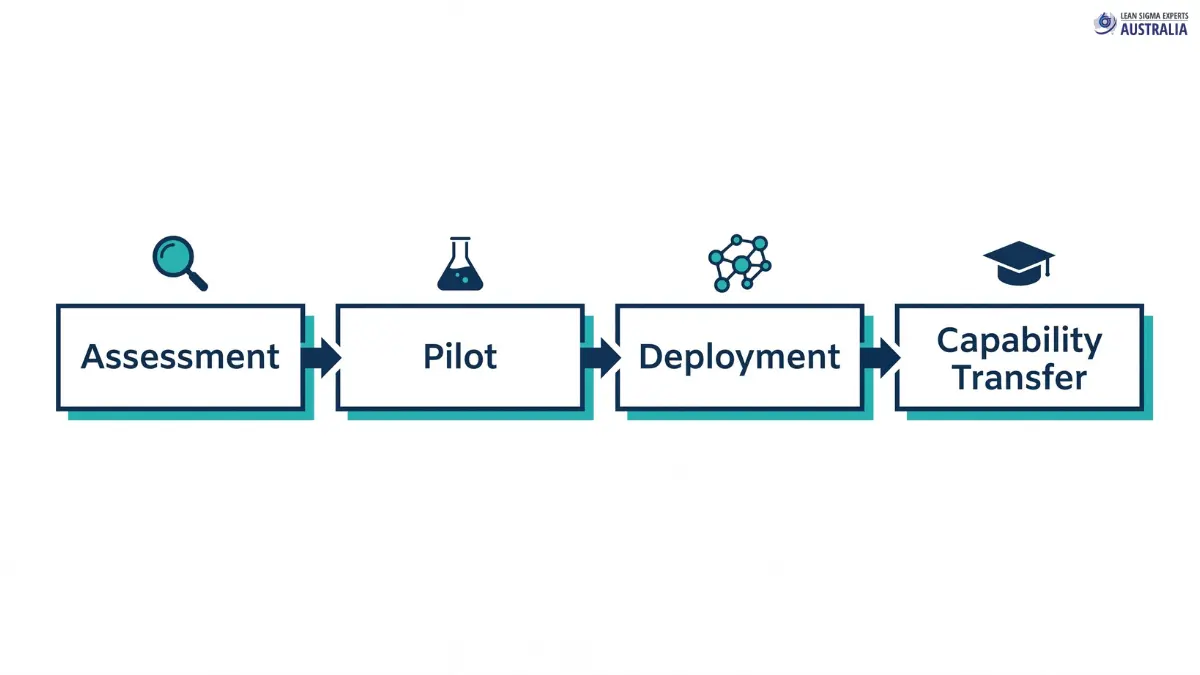
Most credible Lean Six Sigma consulting engagements in Australia are structured in four phases. The phases are sequential, each has an executive-level gate, and each is scoped and costed separately so the sponsor retains the option to stop at any phase boundary if the business case changes.
Phase 1: Assessment
A focused 3 to 5-day engagement in which the consultant assesses current-state capability, identifies the top opportunities for improvement, estimates the financial benefit, and sets out a recommended roadmap. The assessment produces a written report and a prioritised project list. If the findings do not support proceeding, the engagement stops here without sunk cost on pilots.
Phase 2: Pilot
One or two sponsored projects, typically running 3 to 6 months, designed to prove the methodology against the specific operational context and produce measurable financial benefit. Pilots are selected for significance and feasibility: significant enough that the benefit justifies the pilot cost, feasible enough that execution risk is manageable within the timebox.
Phase 3: Deployment
A scaled roll-out across priority business units, typically running 6 to 12 months, in which the approach validated during pilot is applied to a broader project portfolio. Deployment introduces the organisation’s Belt population to live project work under consultant coaching, and establishes the project pipeline governance that will continue after the consultants step out.
Phase 4: Capability transfer
A defined transfer phase in which internal practitioners take ownership of the methodology, the project pipeline, and the benefit realisation governance. Consultants shift from lead to coach, then from coach to advisor, with a scheduled off-ramp. This is the phase that most commonly collapses when the organisation prefers to keep the consultant engaged rather than build internal ownership. Credible consultants insist on the off-ramp because indefinite retention damages the client relationship long-term.
How to evaluate a Lean Six Sigma consultant in Australia
Australian executives can screen Lean Six Sigma consulting firms against a seven-step framework before awarding an engagement. The framework is designed to surface the differences between credible implementation consultants and firms whose primary business is training or certification volume.
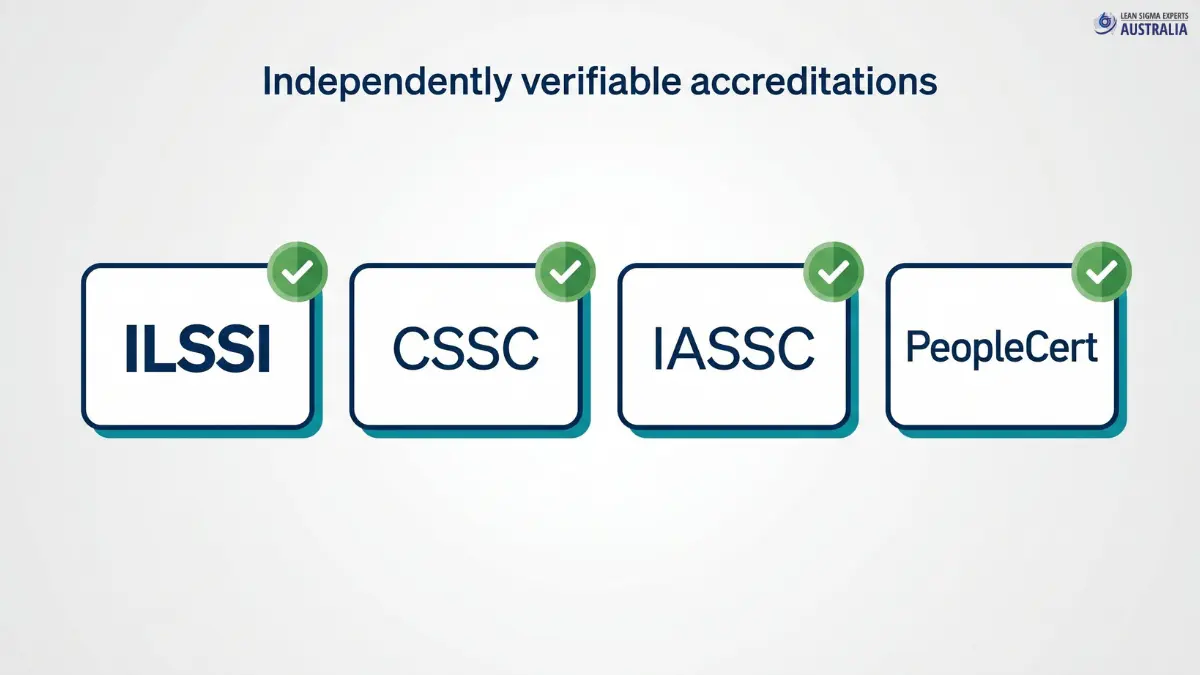
- Verify accredited certifications. Confirm the firm and its named practitioners hold current, independent accreditations such as those issued by the International Lean Six Sigma Institute (ILSSI), the International Association for Six Sigma Certification (IASSC), or the Council for Six Sigma Certification (CSSC). Accreditation should exist at both firm level and individual practitioner level.
- Assess implementation track record. Ask for implementation case studies rather than training volume numbers. A credible consulting firm can point to engagements where they diagnosed a specific operational problem, led or co-led the intervention, and documented the financial outcome.
- Identify named practitioner consultants. Know exactly who will lead your engagement. Qualified Black Belt or Master Black Belt practitioners with portfolio evidence are a different proposition from a firm that staffs engagements with recently-certified trainers or junior analysts.
- Examine the capability transfer model. A credible engagement includes a defined plan for transferring capability to your internal team so improvements continue after the consultants step out. If the commercial model assumes perpetual retainer support, the transfer model probably is not real.
- Check sustained governance support. Ask how the firm supports benefit realisation and process governance after the initial deployment. Look for defined review cadences, performance dashboards, and escalation paths, not vague statements about ongoing advice.
- Match industry and sector exposure. Confirm the firm has relevant exposure to your sector. Manufacturing Lean differs from healthcare Lean, which differs from financial services or government Lean. Ask for analogous engagements in your industry context.
- Review commercial terms transparency. Evaluate how the proposal breaks down scope, investment, and expected outcomes. Opaque pricing, unrealistic outcome promises, or significantly below-market quotes are warning signs that warrant further questions before engaging.
Commercial expectations: investment ranges, engagement duration, outcome timelines
Australian executives evaluating Lean Six Sigma consulting should enter negotiations with realistic commercial expectations. The ranges below are directional, drawn from typical mid-sized Australian engagements, and are intended to calibrate conversations with prospective firms rather than to substitute for a formal proposal.
A diagnostic assessment running 3 to 5 days and delivering a prioritised project list and financial estimate typically sits in the low-to-mid five figures. A pilot engagement running 3 to 6 months and delivering one or two targeted improvement projects with measurable outcomes typically sits in the mid-to-high five figures. A full deployment engagement running 9 to 18 months across multiple business units typically sits in the six-figure range, with the upper bound driven by the number of sites, the complexity of the project portfolio, and the scale of capability transfer required.
Quotes significantly below these ranges should be questioned. They usually reflect one of three realities: the firm is substituting junior or training-only practitioners for qualified consulting resources, the scope has been narrowed in ways that will generate change requests mid-engagement, or the firm is buying market entry at a loss and will look for scope expansion once engaged. None of these is inherently disqualifying, but each changes the commercial risk profile materially and should be discussed openly rather than discovered later.
Outcome timelines should also be calibrated. A well-scoped pilot typically shows measurable result within 3 to 6 months. Full deployment benefit realisation runs over 12 to 24 months. Sustained benefit, measured through the operating rhythm after consultants step out, is a 24 to 36 month conversation. Anyone promising transformational outcomes in 8 weeks is selling a promise the methodology does not support.
What fails most often in Lean Six Sigma consulting engagements
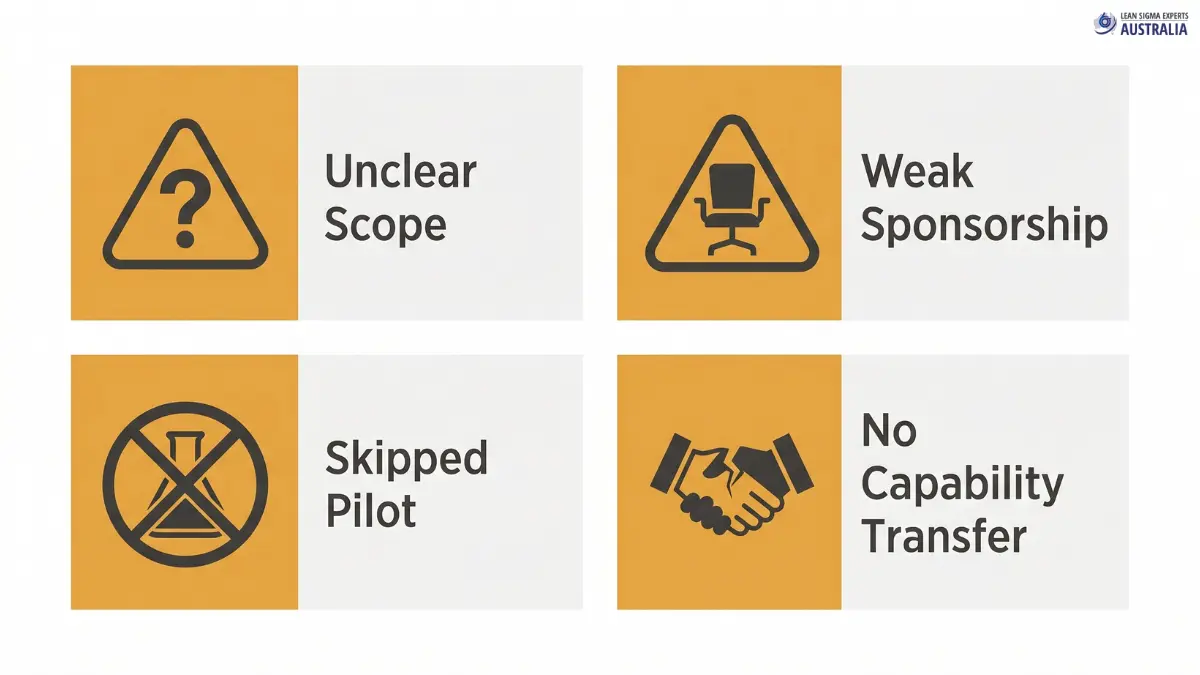
The Australian consulting market has a reasonably consistent list of failure modes in Lean Six Sigma engagements. Most are preventable at the commercial-terms stage, before the engagement begins. Executives evaluating consulting options should screen proposals against the following list deliberately rather than relying on the consultant to raise them.
Scope drift. The engagement starts with a defined problem and drifts into adjacent work that neither party has resourced properly. Fix this in the commercial agreement with a clear change-request process.
Weak executive sponsorship. The nominated sponsor delegates upward and downward until no one is accountable for unblocking the engagement when it encounters internal resistance. Fix this by nominating a sponsor with genuine authority and calendar time.
Training substituted for consulting. The firm staffs the engagement with trainers rather than practitioner-consultants, and the engagement becomes a certification exercise rather than an improvement exercise. Fix this by confirming named consultants and their portfolio evidence upfront.
Missing capability transfer. The consultants deliver improvements but leave no internal capability to sustain or extend them. Fix this by writing capability transfer into the commercial deliverables, with named recipients and assessment gates.
Measurement gaps. The engagement improves a process but the organisation cannot prove the financial benefit because the measurement system does not exist or produces misleading signals. Fix this by including a measurement-system analysis in Phase 1.
Unclear handover. The engagement ends without a defined handover of project pipeline, governance rhythm, and dashboard ownership to internal teams. Fix this by writing the handover into the engagement plan from the start rather than treating it as an end-stage decision.
How Lean Sigma Experts Australia Delivers Lean Six Sigma Consulting Australia
Lean Sigma Experts Australia is the Australian operation of MBIZM Group. The firm delivers lean six sigma consulting australia engagements across mid-sized and enterprise organisations in manufacturing, transportation, defence-adjacent operations, healthcare, logistics, telecommunications, construction, and government-sector bodies.
Engagement leadership
Engagements are led by Dr. Satnam Budwal, Founder of MBizM Group and Principal Consultant for Lean Sigma Experts Australia, who holds a PhD and MSc from Coventry University and a BEng (Honours) from Liverpool John Moores University, with practitioner credentials across the Lean Six Sigma ecosystem including CSSC and IASSC as Accredited Training Associate, complemented by certifications in Certificate IV in Training and Assessment (TAE), ITIL PeopleCert, PRINCE2, Lean IT EXIN, and Cybersecurity ISC2; his delivery portfolio spans approximately 25 years across industries such as automotive, transportation, defence, manufacturing, healthcare, logistics, telecommunications, and construction.
Accreditation
Lean Sigma Experts Australia is the first accredited International Lean Six Sigma Institute (ILSSI) partner in Australia. The firm also holds accreditation from the International Association for Six Sigma Certification (IASSC) under its parent company, MBizM Group, founded by Dr. Satnam Singh Budwal, as well as from the Council for Six Sigma Certification (CSSC). These accreditations are maintained at both the organizational and practitioner levels, ensuring compliance with credentialing requirements across government, defence-adjacent, and regulated-sector clients.
Portfolio context
Lean Sigma Experts Australia operates as part of a broader Asia-Pacific portfolio that includes MBIZM Group’s Malaysia operations. This provides Australian clients with access to a larger practitioner bench for scaled deployments, cross-border reference engagements, and continuity of methodology across multi-country operations where this is commercially relevant. Australian engagements remain delivered by the Australian team; the broader group provides depth rather than substitution.
Next steps for executives evaluating a consulting partner
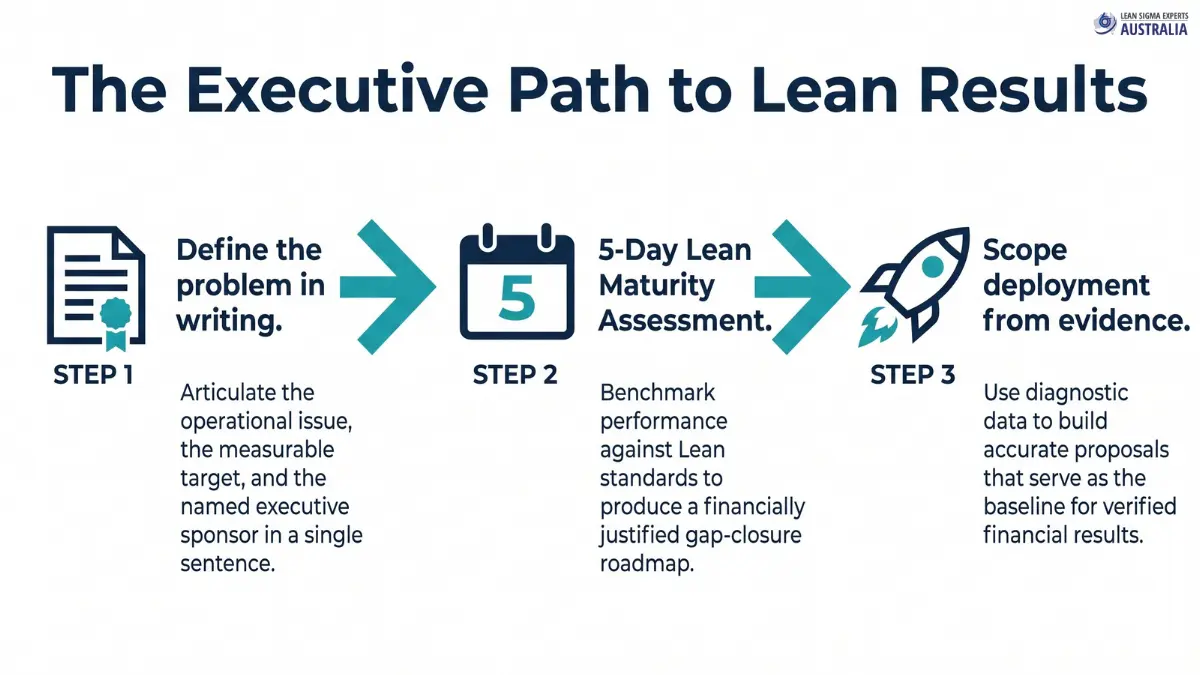
For Australian executives evaluating a Lean Six Sigma consulting partner, the most efficient next step is a focused 30 to 45-minute scoping conversation. This conversation should confirm whether consulting is the right category of intervention, scope the problem, and identify whether a diagnostic assessment is commercially justified. A focused first conversation is short, specific, and productive for both sides.
What to prepare before the first conversation
The following preparation materially reduces the duration and cost of the discovery work that would otherwise be needed in Phase 1:
- A short written description of the operational problem and why it matters commercially.
- A rough estimate of the financial impact of the problem, either as cost leakage or foregone revenue.
- A view on the timeline within which the problem must be resolved and what is driving that timeline.
- The organisational boundaries of the problem, by business unit, site, or process area.
- Current performance data or KPI evidence, even if informal, to support the estimate of impact.
- A named executive sponsor with authority and calendar time to support the engagement.
- A view on the internal team’s current capability in Lean Six Sigma methodology, including any certified practitioners.
- An initial view on commercial envelope, even directional, to confirm the scale of engagement being considered.
Australian organisations that arrive at the scoping conversation with the above in hand typically move through to a structured diagnostic within two weeks, rather than spending six to eight weeks on back-and-forth discovery before Phase 1 can begin.
Frequently asked questions
When should an Australian organisation engage a Lean Six Sigma consultant rather than training internally?
Engage a consultant when there is a defined operational problem with measurable financial impact, a live timeline, and insufficient internal capacity to diagnose, design, and deploy a solution without external guidance. Internal training is the right choice when the organisation wants to build a long-term practitioner population rather than solve a specific current problem.
What does a typical Lean Six Sigma consulting engagement in Australia involve?
A typical engagement moves through four phases: assessment (diagnostic of current-state capability and opportunity), pilot (one or two sponsored improvement projects with measurable financial outcomes), deployment (scaled roll-out across priority business units), and capability transfer (building internal expertise so the organisation can sustain and extend the work without ongoing consulting support).
How long does a Lean Six Sigma consulting engagement take to show results?
A focused pilot typically delivers measurable results within 3 to 6 months. A full deployment across a mid-sized Australian operation usually runs 9 to 18 months, with sustained benefit realisation continuing over 24 to 36 months as capability transfer takes hold and additional projects are launched internally.
How do I evaluate whether a Lean Six Sigma consultant is credible in Australia?
Evaluate against seven dimensions: accredited certifications from recognised bodies (ILSSI, IASSC, CSSC), demonstrated implementation track record (not just training delivery), named practitioner-level consultants with portfolio evidence, a structured capability transfer model, governance for sustained benefit realisation, industry exposure relevant to your sector, and transparent commercial terms with clear outcome expectations.
What is the difference between Lean Six Sigma consulting and training?
Consulting produces operational change: a consultant diagnoses the problem, designs the solution, leads or co-leads the execution, and transfers capability to internal staff. Training produces certified practitioners: a trainer delivers structured course content and certification pathways, without necessarily engaging with the learners’ live business problems. Substantial consulting engagements usually blend both.
Can Lean Six Sigma consulting work in government and public-sector organisations in Australia?
Yes. Lean Six Sigma is widely applied across Australian federal and state government agencies, healthcare providers, defence-adjacent operations, and regulated public-sector bodies. Successful public-sector engagements require consultants with experience adapting Lean Six Sigma methodology to procurement constraints, clearance requirements, stakeholder complexity, and outcome measurement frameworks specific to the public sector.